top of page

Asahi Hiroshi
He was the Fifty-Third Sōke of the Tengu, remembered as the most severe and disciplined of the Hiroshi line. His rule was marked by strict restraint, for he sought to keep the Tengu hidden from the gaze of the world and bound tightly to silence. Under his guidance, the clan withdrew from notice and endured through obscurity rather than influence.
In the year 2014, he willingly laid down the mantle, recognizing that the age had turned and that the path he guarded could no longer endure alone. Accepting the change of times, he allowed his brother’s long-contested vision to return through the next generation, yielding leadership to his nephew, Hiro, that the Tengu might survive in a world no longer ruled by shadows.

Kenshi Hiroshi
He was the Fifty-Second Sōke of the Tengu, remembered as the architect of the clan’s modern form and the one who set its future course. In his youth, before assuming the mantle, Master Kenshi Hiroshi walked a perilous road. In his third decade of life, he served as a hired blade for the Yakuza, carrying out silent killings for coin during an age when the old shadows still clung to Japan’s underworld. This chapter of his life earned him both fear and renown, and its mark never fully left him.
Upon rising as Sōke, he severed those ties and sought to reshape the Tengu, turning it away from mercenary bloodshed and toward survival through adaptation. Though widely respected—and deeply feared—his reforms were met with resistance within the clan. Some, including his own brother, demanded strict adherence to ancient custom and opposed his vision of change.
Master Kenshi Hiroshi was the last of the Tengu to undertake work for the Yakuza, ending such dealings in the 1970s and closing a dark but defining chapter in the clan’s history. He was also the first to teach the Tengu arts to a foreigner and formally petitioned for that outsider’s induction, believing that the clan could endure only by embracing other cultures. This vision was rejected in his lifetime.
Yet his dream did not die with him. More than twenty years later, his son Hiro fulfilled it upon becoming the Fifty-Fourth Sōke, bringing to completion what the Fifty-Second had only dared to imagine.

Jiro Hiroshi
He was the Fifty-First Sōke of the Tengu, the longest to bear the burden of leadership, guiding the clan for more than half a century. From him were born Kenshi and Asahi Hiroshi, through whom the bloodline endured. His reign unfolded during an age of humiliation, when Japan lay beneath the heel of the United States and its soldiers walked the land with careless contempt for its people and traditions.
To survive the storm, Master Jiro Hiroshi cloaked himself in humility. By day he stood as a simple cook, serving food to the occupiers who mocked the old ways. At times, he answered insult with quiet retribution, lacing meals with sickness rather than steel—reminders delivered unseen, leaving no blade to blame.
When night fell and the foreign banners slept, he descended beneath the earth. There, in silence and shadow, he trained the forbidden arts and kept the Tengu alive. Though the nation bent, it did not break, for its spirit was guarded by those who endured unseen.

Kenji Tamura
The Fiftieth Sōke rose not by succession, but by declaration, taking the mantle after the passing of the Forty-Ninth, though Jiro Hiroshi was next by right. For the sake of the clan’s survival, Jiro Hiroshi yielded judgment in his favor. Kenji’s rule endured but two years, ending when his misuse of authority could no longer be borne. He was cast out, and Jiro Hiroshi was named the Fifty-First Sōke, while Kenji faded from the clan in dishonor.

Daichi Hayashi
Recorded as the Forty-Ninth Sōke, he served for many years as Master Oda Hiroshi’s closest companion and aide. Tales remain of his fondness for harmless deceptions, wherein he applied his shinobi skills to confound others, earning both amusement and respect within the clan.

Oda Hiroshi
Recorded as the Forty-Eighth Sōke of the Tengu, he is remembered as the final bearer of the clan’s authentic ninja traditions. By day, Master Oda Hiroshi worked among the paddies like any common man; by night, he moved unseen, trading in information and preserving the last shadow of the Tengu name.
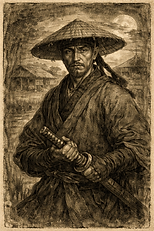
Kin Watanabe
Once a samurai bound by oath, he was made rōnin by the same hands that murdered the Forty-Sixth Sōke. From this betrayal arose the youngest leader in Tengu history, the Forty-Seventh Sōke. Master Kin Watanabe hunted every conspirator tied to the assassination and to his fall from grace, and through blood and resolve came to be known as Vengeful Kin.
Itsuki Hiroshi
The Forty-Sixth Sōke of the Tengu came from humble origins and possessed an uncommon ability to read those he encountered. After entering the Tengu, his ascent was rapid and unquestioned. He was later assassinated by rival shinobi, and the clan nearly fell into ruin, saved only when his youngest student took up the mantle of Sōke.
Daichi Hashimoto
The Forty-Fifth Sōke of the Tengu bore the name the Knife. Stories claimed that he ended lives with a single passing step, the wound delivered without witness or warning, though the truth of these accounts is doubtful. His skill in the art of throwing blades, however, was well attested and widely feared.
Fumio Hiroshi
Recorded as the Forty-Fourth Sōke, he stood as the first of the Hiroshi lineage to claim the title. He was famed throughout his age for mastery of ascent and movement, his body supple and his skill unmatched.
Takao Matsuda
As the Forty-Third Sōke, he lived the life of a samurai by the sun’s rising, bearing steel and honor in plain sight. When darkness fell, however, he abandoned the code of the open blade and returned to the hidden ways of his shinobi brethren, serving the clan in silence and secrecy.
The Sōke who came before the Forty-Third are known only to the void of history, their names and deeds swallowed by time and silence.


bottom of page